Friday, November 11, 2022

Scavenger Hunt! (Victor)

Given the clue “Find the temple where Hideyoshi’s wife Onene spent her final years”. It didn’t take long to find out that my assigned sight was Kodai-ji Temple. A relatively unknown temple when compared to its neighbors, Yasaka Shrine and Kiyomizu-Dera, Kodai-ji is a beautiful site that I personally enjoyed more than Kiyomizu-Dera, the go-to temple in the Gion area. My temple is more toned down and elegant than the other two places I mentioned above, its structures are more simplistic and fewer in number, but each of them are considered historical treasures.

Trying to find the entrance on a narrow residential street.

When I visited Kodai-ji the first time, I knew nothing about it other the fact that is where Hideyoshi’s wife died, and that she had it built to honor his memory after he died. My main focus during this exploratory first visit was to learn my way around the complex, take pictures, and make sure that I could remember the path again when we returned together in October.
Kaisan-do with view of a pond

I absolutely loved Kodai-ji. The more simplistic layout of the buildings lends itself to a quiet space in nature very well. Due to the article I read by William H. Samonides and more of my own research in preparation for touring around again, I learned that it wasn’t supposed to be that way. The complex used to have many more buildings, but due to several fires only six main structures remain. One of my favourites is the Kaisan-Do; it has many paintings from the Tosa and Kano schools.
Famous picture of Kodai-ji maki-e

The Otama-ya, however, is a very special building as it contains much of what Kodai-ji is known for; Momoyama period maki-e, also known as Kodai-ji maki-e. Maki-e is a Japanese style of lacquer where gold or silver dust is sprinkled on the lacquer while it is still wet.
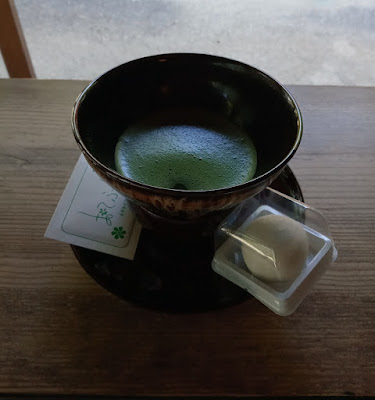
Match and mochi

By far, my favorite part of visiting Kodai-ji was getting a cup of matcha tea while sitting in a tea room. Near the end of the walking through Kodai-ji, you can pay 500 yen to get a cup of tea and a small mochi snack. The perfect way to end a walk around centuries old Japanese buildings surrounded by nature.

Monday, October 31, 2022

Finding Hideyoshi’s Shrine - A Scavenger Hunt (Mahala)

For my scavenger hunt, I was given the hint:

Find the main shrine to Hideyoshi in Kyoto and also the uncomfortable memorial to his invasions of Korea nearby.

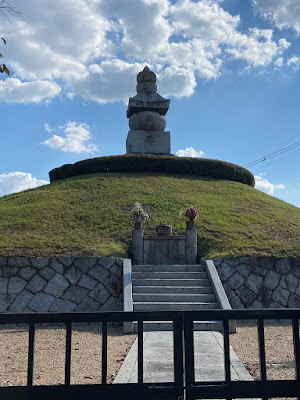
My first step in this journey was establishing what this “uncomfortable memorial” was my assumption that Hideyoshi had many shrines in the country due to his very important status in Japanese history. So, I knew that my location was in Kyoto (because of my university’s location, and the destination of our class trip) and I looked up any Korean memorials that could be connected to Hideyoshi. My research led me to the Mimizuka site. It is the burial mound of the noses of 38,000 Koreans that were taken as war trophies during the Hideyoshi invasions. It is a one minute walk to the shrine that honors the man responsible for the mound.

Upon further research I learned that the shrine has a pretty complicated history. The original site was torn down and buried by Tokugawa Ieyasu and was then rebuilt by Emperor Meiji about 200 years later. The initial destruction was because Tokugawa Ieyasu felt that honoring the man that he replaced was offensive to his position. However, Emperor Meiji believed that the people should honor Hideyoshi to reconnect with their national history and pride.

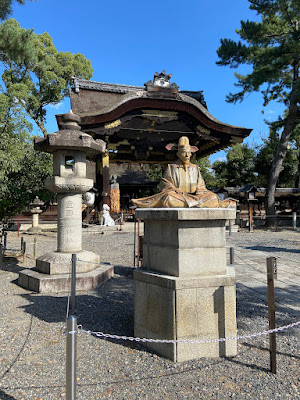
So I had my location and I just needed to visit. On a very hot Saturday, I took the train into Kyoto and first found Mimizuka. I did not stay for long, as it freaked me out to stand in front of something so dark. The gate to the mound was closed, and there was trash in front of it. This made me quite sad. I then walked to the shrine, which was also a short visit since most of the shrine was closed off. I had gone during unconventional hours during the work week, so that’s probably why it was closed. At the shrine, there were the main steps which led to where you drop your 5 yen coins and pray, and they were paralleled with two ema holders. Ema are wooden plaques that people write wishes on and leave them at the shrine. In the front of the shrine there was a statue of Hideyoshi.

These places are significant because of the fact that Hideyoshi was such an important person in Japanese history. He was one of the three men responsible for the unification of Japan. In his time of power, he led two separate invasions of Korea, which resulted in Mimizuka. Later in the Meiji period he became a symbol of Japanese nationalism and identity, which resulted in his shrine being rebuilt. Japanese history would be completely different if not for Toyotomi Hideyoshi.
Mimizuka

Prayer altar

Stature of Hideyoshi


Wednesday, October 19, 2022

Say What? (Victor)

I don’t get to hear a lot of the dialect from my area, Osaka, partially because of my bad habit of staying inside my room when I’m not in class, but also because many of the Japanese students in the seminar house, and around campus always try to use English when speaking to me.
Eat and eavesdrop to learn Japanese.

I tend to hear the most of Kansai-ben when I go out to a cafe or restaurant alone, and I have nothing to do but eavesdrop on neighboring tables.

The two most common phrases I hear are ええで which is equivalent to いいよ, and おおきに, the equivalent to ありがとう. This makes sense considering I hear it at restaurants where phrases like “No problem/okay’’ and “Thank you” are commonplace. I was also specifically taught the phrase おおきに at a small basement restaurant in Kyoto called Teppan Tavern Tenamonya, which I highly recommend. At the end of the meal, they gave us a thank you card that says おおきに on it, and the owner, and chef, of the restaurant made sure we knew what it meant and had us repeat it out loud after him.

Let the bourbon flow! Even though I only got cocktails.

Kansai-ben speakers will probably despise me for saying this but another reason I don’t pick up on the dialect a lot is because most of the time it’s not different enough from Tokyo-ben/standard Japanese that I get confused. If I said that out loud to someone from the Kansai area I’d probably get yelled at. I’ve been told by my Japanese professor here that the people who use Kansai-ben are not only very proud of how they speak, but also specifically have a special hatred and sense of superiority towards people from Tokyo and how they talk. I may be misremembering, but the first time I really noticed Kansai-ben was when I went to a bourbon bar called Rogin’s Tavern in the middle of Osaka where an old man was having a conversation with the bartender that I felt I should’ve been able to understand but was having a strangely hard time. Also, it was my first bar experience so that was pretty fun and funky.

Saturday, October 1, 2022

Say What?: My Experience with the Kansai Dialect (Mahala)

Before coming to Japan, I was aware that the Kansai dialect was a bit weird compared to the Japanese I have been learning for the past 3 years. I was a bit scared because, truthfully, I had no clue what that meant. However, after being in Japan for about 5 weeks now, spoken Japanese does not seem super different like I expected it would. To be honest, I have really heard about 2 or 3 words that belong specifically to the Kansai Dialect.

The word めっちゃ is probably the most common kansai word I have heard. It means ‘a lot’ or ‘very,’ and replaces the word とても. I kept hearing this word all of the time and finally figured out its meaning. Another word is おもろい which replaces おもしろい and means ‘interesting.’ There are probably many other words that are Kansai dialect, however as I learn more every-day language in Japan, these words are never differentiated from “normal japanese.” There have been a couple times where my japanese friend has been asked to give us some words in Kansai-Ben, and she can’t really list more than three things., Kansai dialect is how she speaks, it isn’t anything different or unusual.

To me, adopting these words has been strange. In some instances, when describing something I try to adopt めっちゃ into my sentence and I am unsure whether I am using it correctly. I know I am, but because I learned a different word previously, it feels wrong when I say it. However, as my Japanese improves, I know that being immersed in the Kansai dialect will eventually cause me to use words from Kansai and I think that that is really cool.
A night out in Ebisuhigashi, Osaka.

Monday, September 26, 2022

Mapping the City (Charles S)

Days 1-2

The first two days were right off the bat of being in Tokyo. I hadn’t slept much in the last 48 hours and it was incredibly difficult to accept the reality of where I was. I went to Akita Airport via plane instead of the bullet train due to price (which was surprising as I thought I would be somewhat linked to larger cities via that train.) Upon meeting the staff who were in charge of the bus we drove an incredibly short drive to the University. I would come to know that the views of rice paddies and farms were in the opposite direction of where I came from, so the only thing I could see during that drive was dense vegetation.

The campus’s size was unclear at this time. But after reaching my dorm it was clear that I was on the edge of it. Directly across the street was a huge community garden, filled with many unrecognizable plants. Even the smell of dead plants that fills the air in most rural areas was incredibly different. The first “landmark” that I would say I recognized outside the school was the garden itself, but specifically the garden shed. The shed seemed to be an old bunker, overgrown on the sides with vegetation, and also had spaces for plants and a bridge built into its sloped side. I will link the picture I took of it, as I believe it is the first picture I took in Akita.

The second day I woke up at around 5:30am. My Roomate turned out to be from England, and the degree seeking students would not arrive for another week or so. I had yet to meet any locals, and the place had not yet been properly humanized for me. At around 7am I went for another walk past the garden, further this time to the corner of my street, which is AIU on one half and residential on the other. There I found the konbini. Upon glaring at the katakana for too much time I realized its name was Banafe. I interpreted this to be shorthand for Bananafish, because the logo on the sign was a fish in a banana peel. I still have yet to truly decipher the meaning of that. The moment that would follow is one that I think shocked almost every Japanese learner that walked into the store that day.

I had used Japanese in Tokyo to order food and to ask for directions, so I was confident in communication within Banafu. It is owned by an older married couple, who spoke in what I have since learned is a heavy dose of the Akita Dialect. I knew that the dialect was present here before I came, but I had projected more of a sense of rareness on people actually using it. I couldn’t understand a word that he said past good morning. I did learn that their dog's name is Ku-chan though. I am aware that this essay is sparse in content discussing the map making process, but with so very few landmarks so far the first two days established my center of the world for the next few weeks. That being Banafu, specifically the vending machines and picnic table outside of it, which would hastily become a very social area.

Days 5-7


The next week would have my map expanding from just the campus, and this is where it started to get a little complicated. I went to the local mall this week, as our school's bus stop has a direct link to it. I went to buy cooking materials and things of that sort. I wasn’t quite sure if the area the mall was in (which was a ten minute bus ride away) was considered to be in Akita City itself. I would learn that it isn’t quite there yet. Passing rice paddies and a river, newer buildings and residential areas began to present themselves. Upon checking the bus schedule for the mall me and the kids I was with realized that it would be another 3 hours before the next one back, so we decided to walk it. The walk began as a sort of side of the highway affair. It wasn’t an attractive scene at first, the area where the mall sits is strip mall filled and on a busy road.

We passed gigantic old factory buildings and tangled electrical plants. We soon got back into the countryside, passing the sparse towns throughout the walk, which you could walk through 10 minutes a piece. It darkened and started to rain halfway through the 2 hour walk. So my mind's geography of that direct path is hazy. It seemed like we were deep within the woods and hopelessly far from anything, until the light at the end of the tunnel named Banafu suddenly popped up on the left. That weekend I also passed the local shrine which was deep within the forest between the school and the airport. I found signs for it by trying to find a secluded parking lot to skateboard in, and followed it for about 45 minutes.

12-14 days:


By this point I had been to a big new landmark, as well as the City itself. Both of which were way farther than I expected. The landmark in question is the beach that was recommended to me and other internationals. It was a 45 minute ordeal to get there by train and bus. On the way we stopped in Akita City Station, but didn’t go into the city just yet. To get to the first train you need to take a bus from right outside our cafeteria to the closest town I walked through on my way back from the mall. The town is called Wada, and that is where the closest train access is. The bus ride to Wada is less than ten minutes. On the train we traveled about 7 and half miles to the city, passing more Paddies and different little towns at each spot. The surrounding hills and mountains bowl this area in, their peaks are sharper than the more rounded out hills of the Massachusetts mountains that I’m used to. The train was also significantly more crowded than I thought it would be. At the station we transferred trains and rode another 15 minutes to the town that was next to the beach.

This town was the first time I experienced sights that were familiar to me. Most buildings were abandoned and most windows were boarded up. There were houses made of sheet metal, and very few people around. The town itself consisted of different buildings built along right on the beach before the sand started. There were a few people surfing and the only person I saw outside the water was a carpenter. The beach itself was covered in plastic. Beach toys, bottles, and other assorted plastics peppered the beach. It was saddening, but it was also an important moment to me for reasons I still have difficulty describing.

Ever since I have been here, I have been amazed at the cleanliness of the countryside. Even though I knew cities here were relatively free of street trash, I still hadn’t seen any litter the whole time I had been here. This perplexed me due to the sheer amount of vending machine drinks being consumed by everyone in my close proximity. Everyone sits and consumes them at the banafe, and still the area stays clean. The beach (although it was saddening for us) grounded me in a way. In my head I almost exclaimed “Oh! So this is where all that trash is.” In a messed up way I felt more at home after I saw this. Along with the more impoverished area we were in, this trip assisted me and looked at Akita as a more real place than I had been, and also helped me relate it to the place I call home.

We also went to the city itself a few days after the beach. It was bigger than I thought it would be based on AIU’s landscape. After exiting the station there was an arms race protest as well as a festival featuring Kanto (a local sport that consists of balancing many lanterns on a pole.) None of the kids I was with had sims yet, so we walked around the city hoping to see the castle in the center park. The park was closed so sadly I have yet to experience that, but we could see it poking out of the park as we walked around. The only thing we knew about was a second hand store called Hard Off.

There were surely buses in the city that we could have utilized to get to the store faster, but we were all too overwhelmed and phoneless to utilize them, and so we walked. It took hours to find, and on our way back the sun had began to set. This is when I encountered a new problem. Akita City was pretty barren at night. On our way back to the station we noticed a street we hadn't seen before. It was full of Izakaya and music, and the familiar pop culture fantasy neon signs. Upon further investigation this part of the city was a sort of red-light district. Even though the area had earned itself that title it was still well known to the Japanese kids I met later that it had a fun and busy night scene. I also learned this area only opens up at 9, which is right when the last bus is. Leaving the area we saw many kids our age rushing out of the station we were walking into. It was really nice to see so many people, and feel the rush of population again. Hopefully I can figure out a way to explore the city at night.

Friday, September 23, 2022

Mapping My Way (Victor)


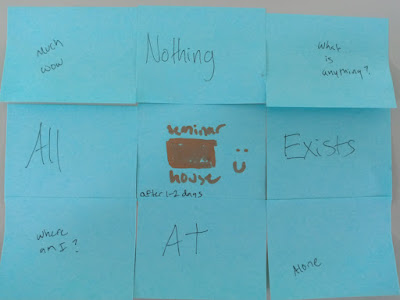
Being as timid as I am, and that my friends were far away from me, living on the college campus while I lived in a building thirty minutes away, I explored as little as possible at first. I only went to the small grocery store five minutes away the next day out of necessity for food, and after it was acquired, I didn’t leave the building again until orientation a couple of days later. I was absolutely terrified of going anywhere by myself. Despite there being a bus stop right outside my building that took me straight to campus, I opted to walk my first several trips because I was too nervous to take the bus alone and I didn’t get a bus pass for almost two weeks because the thought of getting to, and navigating a train station alone was also scary. I didn’t go anywhere I didn’t absolutely have to, and I tried to rope in my roommate or friends for every trip I went on.
My understanding of the world around me represented by sticky notes.

This fear of exploration, particularly by myself, meant that I didn’t have any understanding of my surroundings and even though I walked to campus several times, I was so glued to Google Maps that I didn’t absorb any landmarks.
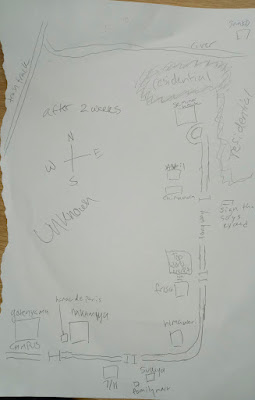
My small world

Even now that I’ve been in Japan for a few weeks, I still haven’t done much exploring, which I regret because I now have less and less time to go out as the semester ramps up. I have my major landmarks, like Himawari, the very bright and bold pachinko parlor that signals where I need to turn right to get to campus from where I’m living. The Top World Market is where I do more extensive grocery shopping trips, and it signals that I’m getting closer to home but my bubble is still so small. For example, I’ve never turned left at Himawari, I take the bus whenever I can, blocking me from taking in information from my environment, and I’m still not comfortable taking the train alone.

Hopefully, I’ll be able to take some bigger steps on my own soon.

Monday, September 19, 2022

Navigating Japan: My Experience in a New City (Mahala)

Today starts my fourth week here in Hirakata and it has been quite the journey to figure out how to get around a country that I have never been to before. Usually when I go someplace new I am with my mother who knows exactly where things are, what to do, and how to get around (if we don’t have our own car with us). It’s been helpful for the last 20 years of my life but now I don’t have her with me to navigate us. I have definitely noticed a difference in how I function in a new environment without her. I am the one person in my family who doesn’t do well with directions so at home I normally try to become familiar with a couple different areas of a city and work out from there. I noticed with this week’s exercise that I have done the exact same thing here.

My first week here, I was still recovering from weird jet lag and attempting to fight the insane heat, so not much exploring was done. However, I was still able to establish some main points of navigation close to me.


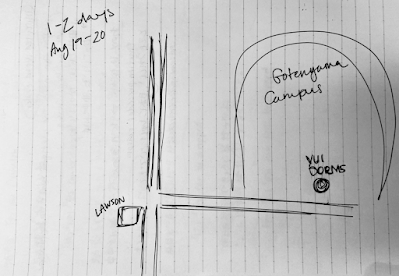
[Map of my surroundings after 1-2 days in Hirakata]

As I said earlier, I didn’t really get out much the first couple of days. The only thing that I actively searched for was somewhere to buy groceries. In this search, I did not stray far from campus. The only thing that I was totally sure of was the Lawson at the end of the street. I did go a couple of other places, but I was following other people at the time and very quickly forgot where we had gone.


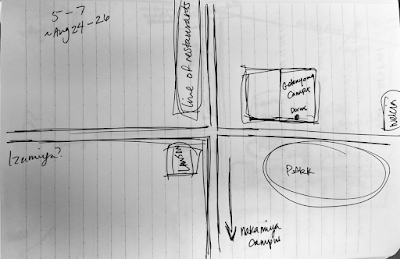
[Map of my surroundings after 5-7 days in Hirakata]

After 5-7 days I was a bit more comfortable with the main intersection next to campus. I found a closer location to buy food that was right next to campus, and I saw that the perpendicular street was the way to Kansai Gaidai’s second campus, and was host to a lot of restaurants.


[Map of my surroundings after 10-12 days in Hirakata]

This is the chunk of time in which I really started to explore. As you can see in the map above, I became a lot more familiar with the main streets next to me and traveled farther down them. I was also able to locate two train stations, and took trips to Kyoto and Osaka. This area of the city is what I have really mastered. I have yet to really travel up the street though, I have only been to the store Izumiya once.

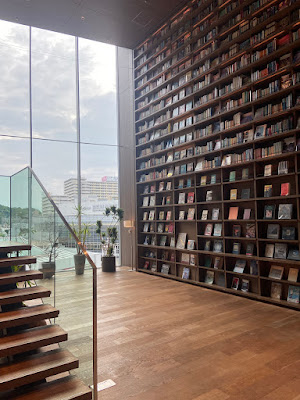
To me the easiest part of navigating is finding landmarks and their immediate surroundings. If we were to use the map as reference for cardinal directions, to the north is the big train station and the Hirakata T-Site which is a big shopping area. To the south is the Nakamiya Campus and is the direction that the bus route runs (seeing as there were only stops on that street). To the east is where I live and is a highly residential area. In fact most of my immediate surroundings in Hirakata seem to be housing.


[Bookstore inside of Hirakata’s T-Site Shopping Area]

Although I am familiar with this area, I still have no clue where I am in reference to Hirakata. I don’t even know my general area on a map. So there is a lot of work for me to do in learning my surroundings. But, I am starting to find exploring more fun than stressful like it was in the beginning. I hope to learn more about Hirakata soon!


[A picture of the main street while on my way back home]

Monday, September 12, 2022

Mahala's Big Day Out (Mahala)

As I set out on this journey I hope to put my mind at ease. The past two school years have been a bit difficult for me in reference to many things that would cause anyone a bit of uneasiness. But this year is going to be completely different for me. I will not really know anyone, therefore I will not feel obligated to spend as much time with others like I did in Beloit; and, I will not have an on campus job, which will give me free time at college that I have never held before. These two things gives me the opportunity to actually have the proper time for my classwork and to have small daily adventures around a place that is completely new to me. I love exploring and am always sad when I can’t see more of the places I visit, but a whole year will give me so much time to explore.

The biggest challenge that I will face is the lack of confidence in my Japanese language abilities. I tend to beat myself up a lot about not being at the right level for my classes, but the other half of me understands that I have never properly had the chance to learn. There is only so much that sitting in a classroom can do for you and your target language.

Time is what I hope to get out of this experience the most. Time to really engage with the hobbies and things that I have lost over the past couple years, time to explore Japan, and time to let the language sink in. I believe that at the end of this year, I will definitely be able to see a difference in myself.

Last shots before I go--reenacting my first day of kindergarten.


Friday, September 9, 2022

My First Big Trip Alone (Victor)


As I set out on this journey I hope to push myself further outside of my comfort zone than ever before. I’ve never been away from home for so long without so much as a weekend back with my family but this time I won’t see my house again for four months. 
Final Look

Of course furthering my language skills is always my goal for studying abroad but I also want to learn to communicate with people that grew up in a completely different environment than I did. It will be challenging to adapt to Japanese culture, as much as I research ahead of time, I can never truly understand what it will feel like to be there until several days or weeks after I’ve gotten off the plane with no reasonable way to change my mind and go home.

Being so far from my friends and family, I expect to be challenged with loneliness and isolation greater than I’ve ever experienced. I won’t be able to text my parents during the day and get a snappy reply, I’ll have to plan calls ahead of time, I’ve never had to do that before. Years ago, I went on a trip to China with my 8th grade Chinese class and I didn’t have much communication back home then either, but I was surrounded by my English speaking classmates and a nice teacher that was constantly checking in on us. I’m mostly alone on this journey, and that’s scary.
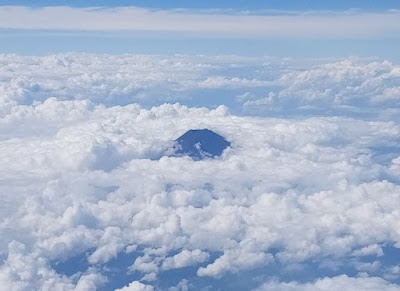
Mt. Fuji from the air

But I also hope to learn how to overcome fears like this and be able to go on more adventures after this one.

Welcome to Kansai Airport, Osaka


Tuesday, November 20, 2018

Say What? (Gray)

For this blog post I was asked to learn a bit of the local dialect and then talk about it, so I went about trying to learn at least a little bit of Akita-ben, the accent native to the prefecture. I don’t have friends who are from Akita, so I had to go outside native speakers to learn. This led me to the internet and our school’s library. There is not a comprehensive dictionary of Akita dialect, as even within the region it can vary, but there are plenty of examples and even a small flashcard booklet I saw in a souvenir shop at the Akita Airport that compares “standard” Japanese phrases and their Akita-ben counterparts.
The first buttons I saw in the airport. 
The dialect is notoriously impenetrable, though through the use of one to one comparisons to phrases I already knew, it became easier to simply switch words out. Some of the nuances of the specific vowel pronunciations that are different from the Japanese I was taught are still unfamiliar to me, but I think that listening to native accent speakers could help me become more accustomed to it.

Another interesting thing I found at the airport’s souvenir shop was a variety of buttons with Akita-ben phrases and their English equivalent with a cute Akita dog character on them. What I found most interesting is that the translations were in English, not in “standard” Japanese. I asked myself if this was an attempt to appeal to the relatively few international tourists who make their way through this further northern region, or just an aesthetic choice as the phrases are common enough in English that ESL speakers would be familiar with them.

Some more buttons featuring Akita-ben
In conclusion, the dialect of Akita is a little harder to seek out than perhaps in regions like Kansai where the accent is more well known. Even with the difficulties in finding resources to learn, I found that I enjoyed learning about how it is similar and different from the Japanese I’d learned before and the ways that it is used both in the region and out.

Monday, November 19, 2018

A Look into Tokyo’s Past (Rylee)

Over fall break I have decided to use my free time to visit one of Tokyo’s many museums. I eventually decided to go to the Edo-Tokyo museum as I wanted to see how they presented Tokyo’s past, and because I have not been to any of the other major museums around Tokyo other than the Miraikan - therefore making it an excellent opportunity to explore more museums.

The Edo-Tokyo museum

Upon my arrival I was greeted by a large modern building standing on 4 pillars. The contrast between the sleek building and the historical nature of the exhibits of Edo was quite surprising. As you enter up the long escalators to the 6th floor you are greeted with a recreation of Nihonbashi – a large wooden bridge in the center of Edo. It served as the symbolic point of entry for travelers to Edo and now it is your entry to the museum. This is where you begin to realize that this museum is highly focused on replicating physical Edo on all scales. The miniatures, interactive exhibits, recreations of housing and objects from Edo to modern Tokyo, and the displays of historical objects all help you immerse yourself into Tokyo from 1603 to the 1960s.
Nihonbashi

In general, the museum is laid out in a chronological order from the foundation of the Shogunate in Edo to the end of the 20th century. The exhibits are straightforward, and the explanations are strongly based upon empirical evidence. The museum accommodates foreign language speakers quite well by offering audio tours and digital displays in over 12 languages. However, as the content of the displays themselves are straight to the point, most of them contain endless amounts of graphs and charts of Edo statistics which forms form my main gripe with this museum - its overwhelming amount of graphs. For starters they are the only things that do not feature full translations that aren’t historical articles. Second, they serve as the main source of evidence behind the reasoning in the English explanations making me feel like I was left out on more of what the museum had to offer. This leaned me toward the feeling that the museum tended to be more cut and dry than your typical museum. Even if I were fully fluent in Japanese, I would still think the museum relies a bit too heavily on solely presenting statistics to allow less written explanations. There was still plenty to read, but the downside that I saw was in the lack of historical narrative leaving the patrons to be the ones to decide what really went on during the Edo period. Little to no explanation seemed to be available on the rise and fall of the Tokugawa regime and emperor Meiji from the view of a common person in that era, but more on the general conditions people went through during these times and less about what was seen in written sources and accounts.

More pie charts than my AP stats class
The Edo-Tokyo museum in general was more of an experience the past type of museum rather than containing any major theme or message type of museum therefore giving it a strongly neutral impression if you don’t interpret it as being some kind of monument to the hardships Japan has endured. You can deduct a lot of the history by understanding why they chose these exhibits and the facts that you are given. However, I assume that the museum expects you to have an all-around knowledge of the Edo period and therefore what the museum offers compliments your knowledge while still offering the bare basics for foreigners and schoolchildren.

Ryōgoku Bridge

More Miniatures

Saturday, November 17, 2018

Akita Dialect (Zowie)

This is at the Namahage Museum. During the performance, they used heavy Akita Dialect. 
Over the past few weeks, I have been trying to learn Akita dialect from classmates, online, and from first-hand experiences. Akita Dialect is known for its relaxed pronunciation being compared to a “lazy” way of speaking. There can be subtle differences, for example, instead of “taberu” (to eat) they would say “daberu” sounding less clear. There are also a lot of words and phrases that are completely different from standard Japanese. One explanation, I read, about why Akita dialect takes on a relaxed pronunciation is because it is so cold in Northern Japan which makes it difficult therefore leading to an unclear pronunciation. While I don’t know how accurate this is I thought it was an interesting explanation for the variation in the language compared to standard Japanese.
“Damagonabe” also known as “tamagonabe” is a soup dish that contains rice balls, various vegetables such as burdock root and spinach, and meats such as beef or chicken. 
While visiting Oga Peninsula in Akita Prefecture with one of my classes, I got to experience native women speaking with heavy Akita dialect. During a cooking session where local women taught us how to cook a local dish called “Damagonabe” a type of soup, one of my classmates, from Tokyo, (where they speak standard Japanese) expressed how she could barely understand what the women were saying. Personally, I could only notice a few instances when the dialect was prominent because my Japanese is not at a level where I can tell the difference yet.

Akita dialect also has several sounds such as ne and ke that can be used for several different meanings. Here is a list of ne examples which is one of my favorite things I learned!

ない=ね(ne) = no

ないじゃん=ねね(nene) = isn’t it?

寝ないじゃん=ねねね(nenene) = I will not sleep

寝れないじゃん=ねれねね(nerenene) = I cannot sleep

寝なきゃ=ねねば(neneba) = I have to sleep

寝なきゃいけないじゃん=ねねばねね(nenebanene) = I have to go to bed

Friday, November 16, 2018

Kansai-ben (Shelby)


I’d heard from many people before I came to Kansai Gaidai that if I went there, I would have to deal with Kansai-ben. I didn’t think much of it, it’s just more Japanese that I would have to learn, or at least get used to, right? So far, that’s mostly how it’s been-- I’ve listened to how people speak, and while some things took longer to figure out, and sometimes an explanation, I figured out the common expressions they use here. I also learned that many students here, or at least many of the ones that I’ve talked to, aren’t from the area and don’t know Kansai-ben.
Kansai Region
A couple of the first words/phrases I heard and noticed were うち (uchi) and ~へん (hen). For the longest time, I could not figure out why people were saying うち. The only thing I could think of when they said it was “house,” and that made no sense at all, making it hard for me to follow the rest of what they said. It wasn’t until a day in Japanese class, several weeks in, that I learned うち is used in the same way as 私 (watashi). After that, things made so much sense since I wasn’t focused on the thought, “What does any of this have to do with a house?”

I had a much easier figuring out when people used へん at the end of their verbs. This was mainly thanks to a lot of context-heavy situations when people didn’t understand either what I was trying to say or they just didn’t know an answer to a question. Then they would use 分からへん (wakarahen) instead of 分からない (wakaranai). It still took a long time to puzzle it out, but I was able to do it myself.
Kansai-ben examples
Since I’ve been here, I haven’t really heard anyone talk about Kansai-ben, other than to say that they don’t know it. The people who do know it, as I mentioned in another post (I think), don’t seem to know which words are Kansai-ben and which are “standard” Japanese. In a way, as Furukawa-sensei mentioned during a recent class, this is kind of a way in which they take pride in their dialect-- they don’t have the same kind of boundaries that those with other dialects in Japan do. They don’t try to speak “standard” Japanese to people because they either don’t feel a need to or don’t know the difference in what they’re saying to what is considered “standard.”

Thursday, November 15, 2018

Osaka History Museum (Keaton)


When I started school at Kansai Gaidai, everyone received a booklet which allows free admission to many museums in the Osaka area. With one of the selected prompts being a trip to a museum, I thought this is the perfect chance to try it out. I chose to go to the Osaka history museum.

The museum was divided into four levels of exhibits. The first level focuses a lot about artifacts from around the Jomon period through the Yayoi period. This includes tools, dioramas of settlement layouts, and religious practices. The theming gave off a very mysterious vibe. There was mostly dark lighting with music played with very “traditional” sounding instruments of flutes and strings.
One of the displays in the first exhibit.
The second exhibit took place in the Edo period and explained daily life and major event during this time. This part felt most like a story where a Bunraku puppet, named Naniwaya, explained every part of the exhibit in an upbeat tone. The last exhibit was about the “Great Osaka Era.” This part is advertised as a look at modern and contemporary Osaka. This floor has large replicas of trains and markets from an early 1900 time frame.
The large set for "The Age of Greater Osaka"
I felt like the story that was being told in this museum is a very positive one. First off, the names for exhibits are grand titles like “The Age of Great Distribution” or “The Age of Greater Osaka”. This also shows in the presentation. Every picture, statue, and cut out has a smile on their face. I had a hard time finding a part of the museum that talked about any negative events or tragedy. This seemed to paint a very nice picture of Osaka, but does not seem to tell both sides of the story. There are also big gaps in eras covered. The museum went from their “ancient” exhibit, to the Edo period, and then to the 1900’s. It feels like there were a lot of events not covered and the museum was very selective in what they presented. Despite my criticisms, I understand that a lot of the presentation is for kids, and it was nice to see the kids engaged in the colorful and extravagant sets they had. And in the end, I am glad that the kids were excited to learn about history.

Monday, October 29, 2018

An Adventure in Fushimi Inari Taisha (Rylee)

Imagery of Kyoto is everywhere. If you were to see Japan as the topic of something, e.g. television episode, magazine article, movie, imagery of iconic places in Kyoto are almost certain to appear. No image more than Fushimi Inari Taisha’s countless torii gates has appeared in popular culture back in the United States when concerning Japan that I have come across, therefore I had to visit the grounds to find out why this place is so popular.
The famous torii path
Finding the place was no difficult task as it is always at the top of tour pamphlets and marked on Google Maps with thousands of positive reviews. Fushimi Inari Taisha is located near a JR train station making it easily accessible compared to other shrines I have previously visited. Shuffle your way through a narrow street of shops and suddenly you reach the main path to the temple grounds. There is no entrance fee and I saw no opening and closing times, therefore you may come and go at your own pace and without the need to hurry or worry about paying admittance. This brings the impression that these temple grounds are more akin to a public park. Free for anyone to use without restrictions, with the added bonus of the beautiful sights.
Main path facing away from the grounds
Fushimi Inari Taisha had a steady number of guests on the day that I visited. It was not crowded to the degree of Nishiki market or downtown Kyoto but there was a noticeably large crowd. Many Asian tourists other than the Japanese seemed to be visiting as the slight majority and the other half seemed to be half Japanese and half Westerners. The Asian tourists seemed to interact with the temple’s amenities to a greater degree. A large crowd of Chinese tourists always seemed to be swarming around the offering boxes, buying gifts, and in general being more energetic. Westerners seemed to stand back and take pictures and spectate.
Stickers everywhere
The area has definitely shown its popularity through its physical features. Stone steps and paths were worn down to be quite slippery and vandalism seemed to be quite higher in comparison to other shrines and temples through litter, stickers and people trying to engrave stuff into the torii and trees. Some of this is to be expected as this temple gets so much traffic to make it feel like a train station but stands as evidence as to why some people do not tolerate tourists. The most important part of my experience though was to see the beauty of the temple grounds. Fushimi Inari Taisha is one of the most quintessential Japan-esque places boasted by many and it definitely shows. It may be due to the overloading of cultural symbols of torii, folklore, and the serene nature of the forest on a mountain, or just our predisposition as tourists as we have seen pictures of this place many times before coming. Our expectations were set beforehand and were well surpassed. The temple’s popularity is expected due to its ease of access and its sheer size. However, Fushimi Inari Taisha does not use any gimmicks as seen in other temples to attract guests, therefore further pushing the point that the temple grounds itself though seemingly rarely modified to meet modern demands can still attract plenty of visitors and remain relevant.

Friday, October 26, 2018

Places to Find (Shelby)

Two weekends ago, October 13 and 14, I met with Furukawa-sensei in Kyoto. After we went to various places for those two days, Furukawa-sensei sent us on our way to find somewhere we hadn’t been yet. There are no shortage of places to visit in Kyoto-- places for tourists, history buffs, or just places you can happen upon by chance. For me, I wasn’t thinking about going to a well-known place that people are likely to know or can easily look up. While those places are important and often nice places to visit, I opted to take another route in finding a place to go, one that I preferred to be on the way back to Hirakata City. Thus, I took to Google Maps to decide for me, and I chose a temple at random to find and visit.

My decision took me to Tobakaido station. From what I saw of the town and the size of the station, the town is likely small and relatively unknown to tourists. I saw few people there and only two foreigners. That being said, from the station, it took roughly 3-5 minutes to walk to the temple I had chosen. Based on what I saw of the town, I wasn’t expecting a large temple, but what I found was even more out of the realm of what I expected; in fact, I almost walked right past it. It was right in between two housing complexes, with one stone post and a wall that you would expect to see at a temple. While I can’t read what was on the stone post, I’m assuming it had something to do with the temple.

Post by the temple entrance
The temple wasn’t really a temple at all-- it was a small space in between the houses around it, where a small, orange altar had been set up. That was all. There were no people, but there were bikes, likely belonging to the people who lived in the houses whose front doors were right next to the small altar. I could tell that it was visited at least kind of frequently, as there were cups that I guessed were offerings on the altar.
Temple gate
I wouldn’t say that I was disappointed in my choice of actions, but I was very surprised that such a small temple would show up on Google Maps. I know, just from going from my house to school, that there are small places like that everywhere in Japan that you can walk past a hundred times before you realize it’s a shrine. I assumed that it was probably just a neighborhood temple.

Thursday, October 25, 2018

Site Discovery in Kyoto (Keaton)

For my field notes, I looked at Nishiki-Tenmangu shrine. Strangely, this was not my first choice in selecting a site to research. I decided to look do my report on this place because of its surprising appearance. The shrine itself is in the middle of a busy shopping district with an arcade, samurai museum, and Wendy’s just a few feet away. While in the middle of this chaos, Nishiki-Tenmangu is behind an open gate which feels like it takes you to another world.

What you see when you walk in
Unlike the rest of the shopping district, the shrine is outside, and like many other places like it, Nishiki-Tenmangu has all the materials most other shrines have: hand washing station, omamori for sale, and ema. The ema, which people write hopes and dreams on, were the most interesting. Since the shrine is right in the middle of a tourist heavy area, there were many ema written in non-Japanese languages. While there were some ema written in various European and Asian languages, about one-fifth all the ema were written in english. From reading the Eenglish ones, I found that most wished for general things like good health and a happy future.

The shrine also has unique characteristics that set it apart from shrines that I have seen in the past. One of the first attributes I notices was the brass bull towards the entrance of the shrine. I saw many times during my visit the bull getting touched and rubbed. It is clear that it is a common occurence from the obvious color change on the statue’s head. Other unique features I spotted were two machines near the head of the shrine. One machine was a robot Kamishibai that told a story by selecting different pictures for each part. The other machine took me a while to understand, but eventually, I saw that it was a fortune teller that uses a mechanical dragon to pick a fortune out of a bowl.
The fortune telling robot also comes with English fortunes 
This place is on of the shrines for Tenjin, a kami for studying. While some may use this shrine for that purpose, I found no English ema about this topic. This may be because of the high amount of tourists that visit this shrine. The shrine does contain many resources for english visitors. This includes detailed maps of the shrine, warning signs, and instructions on shrine etiquette. The shrine seems overall welcoming to tourists, and it is nice to see a shrine that welcomes both the local and the visitor.

Wednesday, October 24, 2018

A Tourist's Perspective - Namahage (Zowie)


On October 12, 2018, I traveled to Oga Peninsula with Professor Furukawa and Gray. During our time there we visited Godzilla Rock, Akagami Shrine Goshado and climbed its 999 steps, the tip of the Peninsula to eat lunch at a delicious restaurant, and the Namahage Museum. Even though Oga is only about an hour away from my university I felt like I had been transported to a completely different place.
The shrine allegedly has 999 steps that were built by the Namahage 
The trees that grow up the side of the mountain appear to be stripped of their leaves and the buildings were dusted with rust from years of salt water eroding the metal. These harsh weather conditions are a reflection of how Oga was formed as a landscape, as a people, and the traditions that came about. And yet, there is still something absolutely breathtaking about this area regardless of its rugged appearance.
Godzilla rock stands fiercely next to the sea.
While in Oga I wanted to look into how the Namahage traditions are being kept alive, as the population decreases. Specifically, I focused on how Oga is marketing to tourists and what has changed as a result of trying to preserve this tradition. While the Namahage has a few different stories about their origin their main purpose is the same. During the New Year Holiday, they come down to the villages to scold and threaten lazy children and sometimes even family members. They come into the house scolding the lazy people and try to take them back to the mountain in a sack. Many kids cry to their parents in fear and run into their protective embrace as it can be quite frightening. However, after eating and drinking sake the Namahage leave good wishes for the family and leave the house only to return again the next year.

At the Namahage Museum you can see the different types that are located in this area. Some Namahage masks are intricately carved while others are made from paper mache or even wood bark.
Fast forward to today, the purpose of the Namahage has shifted in numerous aspects in order to adapt to the new conditions which mostly comes down to the lack of people. Apparently, there are only a dozen, or so, children in Oga and they probably won’t stay to carry on the tradition. Therefore citizens in Oga are forced to adjust the tradition or watch it fade away along with the people. There is a divide between many citizens, some want to create a nicer version of the Namahage as a way to attract tourists and check on the elderly during the winter months; however, some refuse this and would rather have the tradition stay within the community.

I bought a keychain souvenir with the cuter image of the Namahage. This image can be seen in numerous products when marketing to tourists.
The nicer Namahage image popped up often as we traveled around the peninsula. There are cute versions posted on fliers and items such as souvenirs are paired with popular characters such as Hello Kitty and Tamago making them appear much less terrifying then they are intended to be. Even during the performance I watched which is supposed to replicate a night with a Namahage, they didn’t act as they would during a local home visit. They greeted me with good evening and didn’t act out trying to take someone from the home. It was much less fearful than I thought it would be. The other tourists seemed to be smiling and laughing, enjoying the performance, rather than feeling afraid.

There are numerous reasons behind the attitude shift towards how the Namahage should be presented to “outsiders”. But it is apparent that the nice Namahage is the most popular. In the future, I wonder if the Namahage tradition will be sustained as there are less people to take over and what other aspects the community is willing to change in order to keep it alive.

Goshado Mountain Trek (Gray)

We went to the Oga penninsula this week on a field excursion, and decided to climb the 999 steps of the famous Akagami Shrine Goshado. The shrine is built into a mountain, with three large shrine buildings at the peak, along with a holy well and a small building where you can buy good luck charms and fortunes. The main feature of the shrine is the long stone path carved into the mountain. It is nearly vertical in places, but has a couple forgiving slopes. It was used for ascetic training when it was founded as a Buddhist temple in 860, and was converted into a Shinto Shrine in 1860. 
There a five identical shrine buildings at the top, with the center one being larger because it houses the head god of the shrine. 
The shrine also holds interest for those looking to learn about the possible origins of the Namahage, the ever present spirits that are a mascot of the peninsula. According to legend, a Chinese emperor in search on immortality brought ogres to Oga, where they terrorized the local populace. The locals made a deal where if the ogres could build a thousand stairs to climb the mountain up to the shrine in a single night, they would be given a maiden every year as tribute. If they failed, they must never descend upon the village again. The villagers trick the ogres into thinking sunrise has come by making a rooster sound and the steps remained unfinished. This is just one of the many theories as to where the Namahage ritual comes from.
It was quite a trip to the top!
The experience of climbing to Goshado was interesting due to many factors. At the bottom of the mountain there was a basket full of bamboo and wood walking sticks that had clearly seen some use, so our party each decided to take one, yet none of the Japanese climbers had one. It also struck me as strange that there was a whole party of men in dress shoes going up what was very rough terrain without the assistance of a walking stick.

As is typical of most shrines, there was a small building to buy good luck charms that was closed when we arrived. It was very different to the high traffic shrines I had been to in Kyoto and Tokyo and provided valuable perspective on what these historical sites look like in more isolated regions such as Oga.