Monday, October 15, 2018

Student Lounge (Shelby)

One place that I go almost every day of the week is the student lounge in the center for international education on campus. The room is large, with many chairs, tables, and couches, and a large wall in the back showing the time for various places of the world. International students and native Japanese students alike come to the lounge to hang out, do homework, recruit people for events, or take naps. Some people even use the building next to the lounge, where there are large, reflective windows, to practice dancing. I, personally, like to watch them sometimes while I’m there.

People use it as a mutual meeting ground when they need to meet up with someone or get a group together because almost everyone knows where it is. Often times, the Japanese students who are not part of the study abroad prep program go to the lounge to find students that can help them correct their English homework or help them with a project. I’ve been approached by several girls who have asked me to help them correct papers or understand a part of their class reading. Just recently, I was asked by a trio of students in a Japanese linguistics group to help them with a project where they have to teach someone ten Japanese words, so they decided that they would teach me ten words of the Kansai dialect. I was also asked by a few people if I was interested in participating in field trips or volunteer activities.
Volunteer Opportunity Flier from Last Week
The student lounge provides a unique dynamic on the campus, as it is not an exclusive area for international students or students who want to study and it’s not a place where there are any particular set of expectations. People are loud, they play games, do homework, nap, or just do whatever they want to do. Japanese students seem to go there to hang out with other Japanese students rather than to meet international students, which I find surprising, as it’s probably one of the most densely populated places in terms of where international students go. And, as someone who has the chance to sit in the lounge for extended periods of time, mainly over lunch, it’s interesting to see the amount of people who come to the lounge to eat lunch. As soon as lunch is over, the room quickly empties and becomes incredibly quiet. And even then, when people are in class or eating lunch, there’s almost always people dancing outside.

Friday, October 12, 2018

Japan’s Gashapon (Keaton)

When looking at what I was consuming here in Japan, the gashapon, or gacha, is a strange decision I settled on. This is because I have not been buying a lot of gachas (compared to my friends anyway), but I believe this is not the only thing involved in the culture of gachas.

First off, gashapons are small dispensers that give out a small item depending on the gacha you use. These items range from small magnets that cost around a 100 yen to a modest size figure that can cost around around 500 yen. These little machines can be found almost anywhere and can be found in groups. While you find a lot of these in groups of around six, there are some places that can contain rows and rows of these dispensers.
Example of a typical gacha station.
America also has gacha, but on a smaller scale. Supermarkets may have a small candy or bouncy ball dispenser near the entrance that costs 25 cents, but Japanese gacha give off a different feel. The items you get from gacha differs depending on the machine; however, most of the gachas are anime related. By appealing to fandoms, Japanese gashapon gain more incentive to buy than a 25 cent bouncy ball. Not only this, but the items you receive are quality products you could buy at comic stores like keychains and pins.
One of the items I was able to get.
But like I said, I have not purchased from a lot of gacha, but I still feel like I am a consumer unlike some customers I have watched which come to machines with a cup of 100 yen hellbent on getting the one they want. For me, like the gambling high of getting the right keychain, there is also a high in finding the right machine to use. Since gashapon cover many properties, there is always new gacha to find, and finally finding the one with the show that you like is a exhilarating feeling. I even biked an hour out of my way to just use the gacha because my friend told me of a gacha I was looking for.

Gacha are more than just a machine on the side of the street. However small they may be, the nicknacks you can get from gashapon can be a way to show off your interests for just a small small price. While the item may be nice, finding the gacha you have been searching for is half the fun. While I do not buy a lot, I am always waiting to find the the one gacha that will make my day.

Thursday, October 11, 2018

Yokoso, YouTube! (Gray)

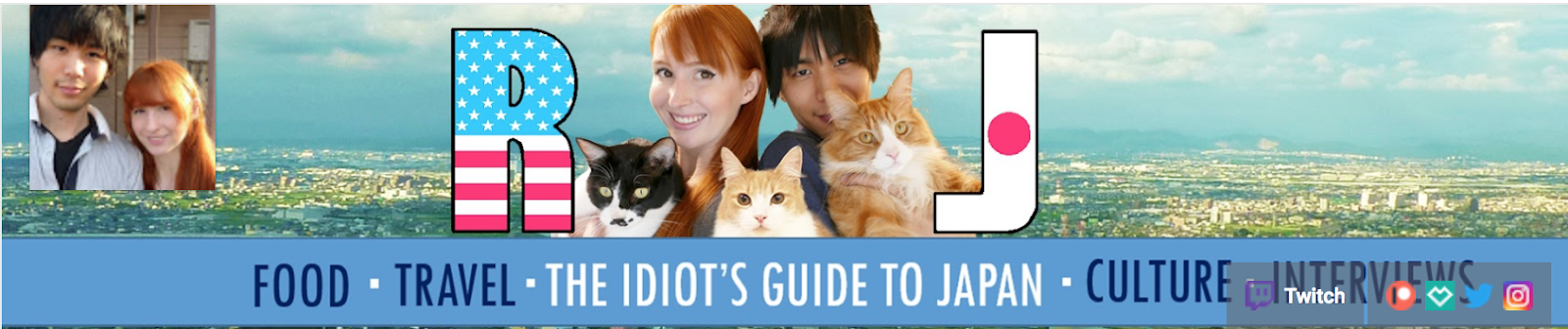
My prompt for this week was to become a “fan” of something. Though I am a regular at the campus conbini, I decided it would be interesting to take my research to a digital space: YouTube! In the course of my time in Japan so far I have picked up several Japanese YouTube channels that I watch regularly, though I had started watching one while I was still in the U.S. The ones I’ll be talking about, because I watch them most regularly, and have participated in their comments section, are a prank/comedy channel called SUSHI RAMEN [Riku] and a cooking/vlog network of channels run by Rachel and Jun, an American/Japanese married couple living in Japan.

Banner from Rachel and Jun's main channel, where they mostly post in English about life in Japan. Jun has a cooking channel of his own.
The general flow of consuming these videos is dependent on if a new one has been uploaded. While some channels have a more regular upload schedule, others are more scattered in their upload times. When a new video was uploaded, I would watch and comment, usually in Japanese but there were some channels with majority English comments. The content of the videos on these channels varies but I’ll give an example of a recent video by SUSHI RAMEN [Riku].
Thumbnail and description from SUSHI RAMEN [Riku]'s most recent video.
By the thumbnail and editing you can tell that he takes a lot of inspiration from Japanese comedy variety shows, with colorful subtitles in Japanese as well as general absurd video concepts, like building a slide from the front door to the living room with guitars attached to the sides so he can play a song when he comes home from his part time job. This, while patently ridiculous, is enjoyable because of [Riku]’s personality and his unique editing style. 

The majority of comments on [Riku]’s channel are in Japanese, with the occasional one-off English comments remarking on how “Japanese” his videos are. My attempts to engage in the comments were mostly in Japanese, garnering a couple likes but no replies, which I in general expected. The comments section of a Youtube video is not the best place to have conversations with other fans as there are a lot of comments and it is easy to get lost in the shuffle.

I think in future I should also ask my Japanese friends and my roommate what YouTube channels they watch, so I can watch the same things and have discussions with them from that. I was particularly interested in investigating a form of pop culture created by the individual instead of by larger companies and industries. It was interesting to see how the content on YouTube borrows from more traditional mediums like television, and the cultural specificity of those references. But all in all, I encourage my fellow students and blog readers to check out Japanese YouTube! You never know what you’ll find!

Wednesday, September 26, 2018

The Search for General Nogi’s Grave (Rylee)


My task for this scavenger hunt is to find the grave of the general who committed ritual suicide following Emperor Meiji’s death. This at first did not seem too difficult since I have learned about this event in a Japanese history class. It was General Nogi Maresuke and it was quite surprising to have someone highly regarded commit ritual suicide – an act that was a rare occurrence even a century ago when medieval traditions were long gone.

So, I searched some sources on the internet to refresh my memory and luckily the Rikkyo library had the same books in their collection that I used in my history class. When it came down to finding the exact location of the headstone most of my research was sourced from Google maps, a postcard collectors’ website, and findagrave.com which helped immensely me in identifying the gravestones of Nogi and his wife who also committed ritual suicide.

I set off to what I learned to be the location of Nogi’s headstone – Aoyama cemetery. It was actually very close to the Nogi shrine and his residence, so finding the approximate location was not difficult. However, finding the gravestone in the massive cemetery was the most difficult aspect of the scavenger hunt. All I had to base my search on is what the two headstones of him and his wife looked like, and it wasn’t terribly difficult in retrospect since they are big boulders in a sea of polished and cut headstones.
Aoyama Cemetery
After a half hour of walking around the cemetery I managed to come across a little gated in area in the northeast corner of the cemetery where the two headstones reside. Even though I was the only person in sight and there was no lock on the gate itself, I decided not to create a fuss and try to figure out how the gate worked, so I just stuck my camera in-between the metal bars to take some photos.
The gated area of the two headstones.
The stones did match up with the pictures I have seen previously, and I did recognize the kanji for Nogi Maresuke’s name, so I am certain this is the spot I am looking for. There was a lot of other headstones in the gated area, much of which I have no idea about other than them being family members. In general, my understanding of Japanese cemeteries and the post-death process is extremely limited. I assume everyone is cremated and their ashes are placed in these stones which makes me doubt using the term ‘headstone’, but I could be wrong. It is something I want to look into further and would enjoy learning about Japanese religion in general.
The two headstones
In the end I did not end up making it to the Nogi shrine and residence to further my understanding due to my exhaustion at the end of my search of the grave. I hear I just missed the day when they open Nogi’s house to the public on the day of his death – September 13 when I just went to the cemetery on the 19th. Much of what I learned through the process about Nogi himself and the end of the Meiji period was my research conducted through rereading some parts of Donald Keene’s Emperor of Japan: Meiji and his world and Japan a Documentary History by David J. Lu. The death of Nogi Maresuke was a controversial one and casted many doubts on Japan’s future direction. It affected many citizen’s lives and jogged my memory on Natsume Soseki’s mentioning of the impact of Nogi’s and Meiji’s death. With his death being reacted to by many people it raises the impact I witnessed in my research and definitely is an event not to overlook. In general, it created a bleak outlook for Japan after the death of the popular emperor Meiji and the following event of Nogi’s ritual suicide.


Friday, September 14, 2018

Settling in to Shiinamachi (Rylee)

It has nearly been a week since I have arrived in Tokyo and settled down in Rikkyo’s housing in Shiinamachi. It is quite surprising how quiet and homey this neighborhood feels even though it is only a 15-minute walk away from one of the busiest places in Tokyo. It contains all of your small-town amenities such as a barber, drug store, a few restaurants, a produce grocer and of course all of the convenience stores and chain establishments. My apartment resides on one of the main streets going directly north from Shiinamachi station. This allows me to walk through the neighborhood’s center and see what’s happening on my way to and from the dorm. The more time I spend witnessing the town do its daily routine and visit the stores the more I feel like I am a citizen of Shiinamachi.
My first map
My initial map is very lacking in detail on streets and locally owned stores. Streets on one hand seem to spiral off into random directions as they very rarely follow the four cardinal directions which makes my walk to Rikkyo a bit complicated if I want to take the shortest route since I cannot just walk East. Stores are something that I discover each day. I see their signs but many of them I do not know their function. Just recently I found out a place named Red ended up being a barber even though I thought it was a bar with its neon lights and tinted windows.
Street to the station
A festival was held last Saturday evening, and all of the shops and vendors were open for regular business and were also selling food and toys in stalls, allowing me to see much of the insides of stores and what they were selling. I am glad to see that many family-owned places are still open. In the United States similar stores would be out of business due to fierce competition from major chains. It surprises me that they can coexist to a better degree than the U.S. even though Japan also has major shopping chains and convenience stores.
Saturday night festival
For each day I walk around Shiinamachi my mental map of the town grows, however there are physical limits I set in place that determine the boundaries of Shiinamachi. The busy avenue to the east and north sets the barrier between busy Ikebukuro and calm Shiinamachi. However, I have not traveled too far South or West as it is more residential areas. As a matter of fact, I don’t know what to make of that area as I have no bike and friends tell me there is not too much in those directions within walking distance. The boundary between Kanamecho and Shiinamachi also seems to be nonexistent. I assume stations are named after their neighborhoods in most cases, but Kanamecho to the North is right on my boundary of the two avenues as it is a subway station underneath the busy road. There seems to be no town center for a subway station unlike a train station. It makes you wonder what a community or town in Tokyo needs to be put on the map.