Showing posts with label Gray. Show all posts

Tuesday, November 20, 2018

Say What? (Gray)

For this blog post I was asked to learn a bit of the local dialect and then talk about it, so I went about trying to learn at least a little bit of Akita-ben, the accent native to the prefecture. I don’t have friends who are from Akita, so I had to go outside native speakers to learn. This led me to the internet and our school’s library. There is not a comprehensive dictionary of Akita dialect, as even within the region it can vary, but there are plenty of examples and even a small flashcard booklet I saw in a souvenir shop at the Akita Airport that compares “standard” Japanese phrases and their Akita-ben counterparts.
The first buttons I saw in the airport. 
The dialect is notoriously impenetrable, though through the use of one to one comparisons to phrases I already knew, it became easier to simply switch words out. Some of the nuances of the specific vowel pronunciations that are different from the Japanese I was taught are still unfamiliar to me, but I think that listening to native accent speakers could help me become more accustomed to it.

Another interesting thing I found at the airport’s souvenir shop was a variety of buttons with Akita-ben phrases and their English equivalent with a cute Akita dog character on them. What I found most interesting is that the translations were in English, not in “standard” Japanese. I asked myself if this was an attempt to appeal to the relatively few international tourists who make their way through this further northern region, or just an aesthetic choice as the phrases are common enough in English that ESL speakers would be familiar with them.

Some more buttons featuring Akita-ben
In conclusion, the dialect of Akita is a little harder to seek out than perhaps in regions like Kansai where the accent is more well known. Even with the difficulties in finding resources to learn, I found that I enjoyed learning about how it is similar and different from the Japanese I’d learned before and the ways that it is used both in the region and out.

Wednesday, October 24, 2018

Goshado Mountain Trek (Gray)

We went to the Oga penninsula this week on a field excursion, and decided to climb the 999 steps of the famous Akagami Shrine Goshado. The shrine is built into a mountain, with three large shrine buildings at the peak, along with a holy well and a small building where you can buy good luck charms and fortunes. The main feature of the shrine is the long stone path carved into the mountain. It is nearly vertical in places, but has a couple forgiving slopes. It was used for ascetic training when it was founded as a Buddhist temple in 860, and was converted into a Shinto Shrine in 1860. 
There a five identical shrine buildings at the top, with the center one being larger because it houses the head god of the shrine. 
The shrine also holds interest for those looking to learn about the possible origins of the Namahage, the ever present spirits that are a mascot of the peninsula. According to legend, a Chinese emperor in search on immortality brought ogres to Oga, where they terrorized the local populace. The locals made a deal where if the ogres could build a thousand stairs to climb the mountain up to the shrine in a single night, they would be given a maiden every year as tribute. If they failed, they must never descend upon the village again. The villagers trick the ogres into thinking sunrise has come by making a rooster sound and the steps remained unfinished. This is just one of the many theories as to where the Namahage ritual comes from.
It was quite a trip to the top!
The experience of climbing to Goshado was interesting due to many factors. At the bottom of the mountain there was a basket full of bamboo and wood walking sticks that had clearly seen some use, so our party each decided to take one, yet none of the Japanese climbers had one. It also struck me as strange that there was a whole party of men in dress shoes going up what was very rough terrain without the assistance of a walking stick.

As is typical of most shrines, there was a small building to buy good luck charms that was closed when we arrived. It was very different to the high traffic shrines I had been to in Kyoto and Tokyo and provided valuable perspective on what these historical sites look like in more isolated regions such as Oga.

Thursday, October 11, 2018

Yokoso, YouTube! (Gray)

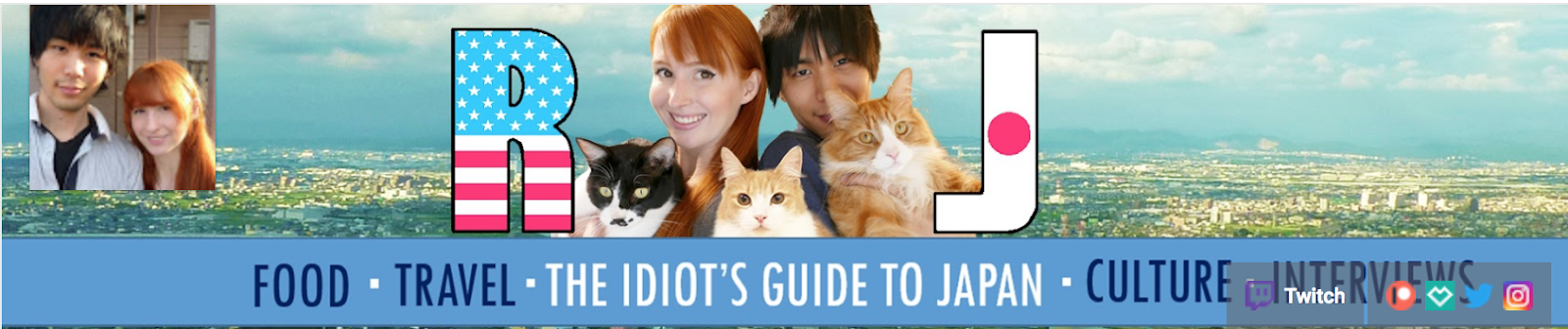
My prompt for this week was to become a “fan” of something. Though I am a regular at the campus conbini, I decided it would be interesting to take my research to a digital space: YouTube! In the course of my time in Japan so far I have picked up several Japanese YouTube channels that I watch regularly, though I had started watching one while I was still in the U.S. The ones I’ll be talking about, because I watch them most regularly, and have participated in their comments section, are a prank/comedy channel called SUSHI RAMEN [Riku] and a cooking/vlog network of channels run by Rachel and Jun, an American/Japanese married couple living in Japan.

Banner from Rachel and Jun's main channel, where they mostly post in English about life in Japan. Jun has a cooking channel of his own.
The general flow of consuming these videos is dependent on if a new one has been uploaded. While some channels have a more regular upload schedule, others are more scattered in their upload times. When a new video was uploaded, I would watch and comment, usually in Japanese but there were some channels with majority English comments. The content of the videos on these channels varies but I’ll give an example of a recent video by SUSHI RAMEN [Riku].
Thumbnail and description from SUSHI RAMEN [Riku]'s most recent video.
By the thumbnail and editing you can tell that he takes a lot of inspiration from Japanese comedy variety shows, with colorful subtitles in Japanese as well as general absurd video concepts, like building a slide from the front door to the living room with guitars attached to the sides so he can play a song when he comes home from his part time job. This, while patently ridiculous, is enjoyable because of [Riku]’s personality and his unique editing style. 

The majority of comments on [Riku]’s channel are in Japanese, with the occasional one-off English comments remarking on how “Japanese” his videos are. My attempts to engage in the comments were mostly in Japanese, garnering a couple likes but no replies, which I in general expected. The comments section of a Youtube video is not the best place to have conversations with other fans as there are a lot of comments and it is easy to get lost in the shuffle.

I think in future I should also ask my Japanese friends and my roommate what YouTube channels they watch, so I can watch the same things and have discussions with them from that. I was particularly interested in investigating a form of pop culture created by the individual instead of by larger companies and industries. It was interesting to see how the content on YouTube borrows from more traditional mediums like television, and the cultural specificity of those references. But all in all, I encourage my fellow students and blog readers to check out Japanese YouTube! You never know what you’ll find!

Monday, September 10, 2018

Finding the Way (Gray)

In the first couple days of my exploration of AIU and the surrounding area, I realized how close together most of my initial “points of interest” were. In the beginning I was looking for the essentials: where did I have class, where could I buy food and what the fastest paths across campus were. As I continued to look beyond AIU itself, through word of mouth I found things a little bit further out, like shrine about a 20 minute walk from campus, or the far edge of the prefectural public park. Just a short bus ride away was the Goshono area, with its variety of shops, gargantuan mall and a convenient shuttle into the main station of Akita City.
First map I made of the area.
Despite the diverse locations I’ve become more familiar with, a constant about Akita more generally is that there is an immense amount of greenery. When I walked the perimeter of the large mall in the area, I found that the other side of the road, if not small shopping centers, was largely overgrown green space. At the edges of AIU campus itself are forests of the cedar famous in this prefecture. I think that coming from American Suburbia, the amount and inescapability of the greenery here is very different from home.
AIU campus is home to lots of these crows.
In the beginning I felt more and more like an outsider the further I went from campus, with my height and very visibly foreign face setting me apart. Though as time progressed, although the situation did not change, I found myself caring less that I stuck out, as if my growing familiarity with the area, as well as my residence status, gave me as much as a right to those public spaces as any other person. I don’t think I will ever truly feel inconspicuous outside of AIU campus, but I’ve come to terms with that. AIU campus feels like a bubble, with everything I need for the semester contained inside it, so I can see how it would be easy for an international student to stay on campus most of the time.

Overall, throughout my journey in exploring and mapping my neighborhood thus far, I found that, unlike my small time in Tokyo earlier this summer, there are liminal spaces between “neighborhoods” here in Akita. Here, between larger more developed areas are stretches of farmland and residences that feel disconnected from what I consider to be in my “neighborhood”, so that the areas I do feel like are my “neighborhood” are small pockets inside of a larger structure that is less accessible to people without cars, as public transit only goes to certain places. I was surprised, all in all, that I did as much exploring as I have, and look forward to exploring even more throughout the semester.
Onwards into the unknown!


Monday, September 3, 2018

Journeys, Goals and Packing Up (Gray)

As I set out on this journey, I feel as though no preparation I could possibly do would adequately prepare me for what I’m about to do. I am a nervous traveller, easily flustered by the smallest trevails, and though I’ve been studying the language for a long time and can get around alive, am awkward and stilted in conversation with native speakers. Where I am now as a student of the language is a strange position where I still need to work on my memorization of kanji and translating what I want to say into coherent statements. I am only shakily sure of my ability to navigate the interpersonal relationships I will have to create when I arrive, as existing in a culture I’m not native to may be a challenge. I’m hoping to learn more of the academic phrases in Japanese and the cultural terrain of AIU as it compares to the rest of Japan and to Beloit, with the hope that I can bring things I’ve learned outside the classroom back to Beloit in the spring.

My other home away from home.
I think that the key to getting over the homesickness I’m already feeling is to throw myself at studies and clubs, and try to fill up my time as much as possible. I want to be productive and make the most of my time there, so I’m hoping that I will have opportunities that I can seize, including field trips and the ability to get out into the community.

I think it helps that I have been to Akita before, earlier this summer, so the lay of the campus isn’t a complete mystery to me. The area around, going towards Akita City proper, feels like a world away based on the short time I was there before. I hope to learn as much as I can about how the city and surrounding area are different from the places my classmates are studying in, as well as how the other students at AIU navigate the community differently than I do.

I will be happy to be back in Japan!

Here's the the start of a new journey!