Showing posts with label Paula/ポーラ. Show all posts

Saturday, October 25, 2014

Pop Japan (ポーラ)


Because Akita is an international university with a high number of Western – and particularly American – exchange students, I am simultaneously exposed to Western and Japanese styles of interest in Japanese culture and pop culture (Western culture too.  We’ll come back to that).  With the significant exception of Studio Ghibli – there is a general lack of interest on the part of the Japanese people at AIU in Japanese pop culture as a whole.  My feelings on Japanese interaction with pop culture are that they are similar to America with a different skin applied.  As is true in America, everyone knows larger pop stars (ex Lady Gaga; Kyary Pamyu Pamyu), generally watches poor television shows (read some dramas and anime) despite the existence of good ones, and pays much more attention to youth fiction (light novels) than to literature.

I had the good fortune this month to go to a free music festival in Tokyo in which Kyary Pamyu Pamyu performed.  For those who are not familiar with Kyary, please see the attached video.


Pretty remarkable, isn’t she?

Even in Japan, Kyary has created quite a stir.  By remaining very respectful and maintaining traditional Japanese values in interviews and public appearances, she has managed to create an interesting balance of critiquing current Japanese pop music and social tropes, while also being mainstream.

For instance, here is a video of her performance of “Pinpon Nannai” – a song I propose critiques fat-shaming in Japanese society as well as general feelings of unhappiness in every-day life.


Despite the stated intention of augmenting tourism within Japan for the foreigners staying here, the only reason I can see to provide free tickets and food (score) to a music festival in Tokyo featuring your most popular (and most internationally known) popstar is because the music business has globalized.

With the advent of K-pop in PSY(of the incredibly popular Gangnam style and Gentleman), Girl’s Generation (single “The Boys” entering top 100 on iTunes), and other similarly popular other groups, Japan has watched one of its literal and in many ways cultural neighbors rise to mild international pop culture stardom.  I suspect that this event hoped to popularize J-pop overseas.

Although I think that Japan certainly has the marketing ability to make its pop music sell well overseas considering the luck it has had with many of its pop characters, and even Vocaloid, I think it says something about the industry that even my friends at AIU rarely are interested in J-pop or J-rock above their European, American, and Korean counterparts.  This is true despite an obvious (although potentially less potent at AIU) language difference.  Please put your thoughts on this issue in the comments!

Friday, October 24, 2014

Re-remembering Japan (ポーラ)

Along with our professor, Dylan, Janae and I went to the town of Kakunodate on the 14th of October.  The new phenomena of the October typhoon had just swept through Akita the night before leaving the streets a dangerous glistening mess of black pavement, oil, water, and leaves.  Although early for the changing of the leaves – a sight deemed especially beautiful in Akita prefecture – the edges of the still green sakura trees hinted at what was to come.

Kakunodate is a preserved samurai town.  It has many different small museums of sorts all stationed within old samurai homes.  During our visit, we traveled to two such homes.  The first we visited was the Ishiguro house.  It was the home of the highest ranking family in this district and was very large.  The part of the house accessible to visitors about 4-5 rooms all of about 6-8 tatami mats.
The second home was that of the Aoyagi clan.  This manner was significantly more museum-like.  It was also considerably more difficult to distinguish what parts of the manner were historic and which parts were added during later builds.  Admittedly it is probably easier to determine if you can speak Japanese.


Although another of my classmates has already written his thoughts on the association of Kakunodate and Edo-fying the past, I would like to respectfully disagree with his perceived lack of connection between Gluck’s work and the preserved samurai village.  I think that the way that information was presented in these houses for the most part ignored history prior to the Edo period.  The history presented in these preserved homes began with the rise of the samurai and particularly in the case of the Aoyagi manor, carried a relatively singular thought path all the way to the current day.  As someone who is not terribly interested in history (sorry Rob), and as someone who has not intensively studied the ways in which museums present their information I am not qualified to give anything other than my own personal perspective on this.  I would guess museums across the world have similar difficulties integrating history into a larger timeline.  That said, from what I have read about in regards to painting history for the use of propaganda etc, manipulation of the timeline is common.  Therefore, I think the emphasis on this particular time period within these museums and their preservation as Akita’s history is potentially revealing to someone who knows more than I.  If you get the chance, do go.  Many places in the area are relatively understanding towards English speakers, and even if not, the large amount of artifacts and their display should be revealing to people who are familiar with this time period.

Thursday, October 23, 2014

Becoming Japanese (Paula)


One thing that might surprise a foreigner (or at least an American) traveling in Japan are the hours. Even in Beloit, small town Wisconsin, stores are commonly open until 7pm and some stores will be open until 9pm or as late as 12am. In Akita (Akita City, not just tiny AIU), shops start shutting down at 5pm, and all typical stores are closed by 9pm. This can be a problem in a prefecture famous for its sake and a strong drinking culture (much like beer-drinking in Wisconsin). After-hours you have three main options:

 As is typical in Japan, AIU provides vending machines as a consolation prize. Our single snack machine in located in Komachi lounge. They fill said snack machine at least three times a week. It is nevertheless empty about half the time.

 The bar serves food. Although nothing in the bar (with the exception of shots) costs less than 500Y, the prices are very reasonable and all of the food is surprisingly delicious and varied considering they make it all in a kitchen the size of my dorm room.

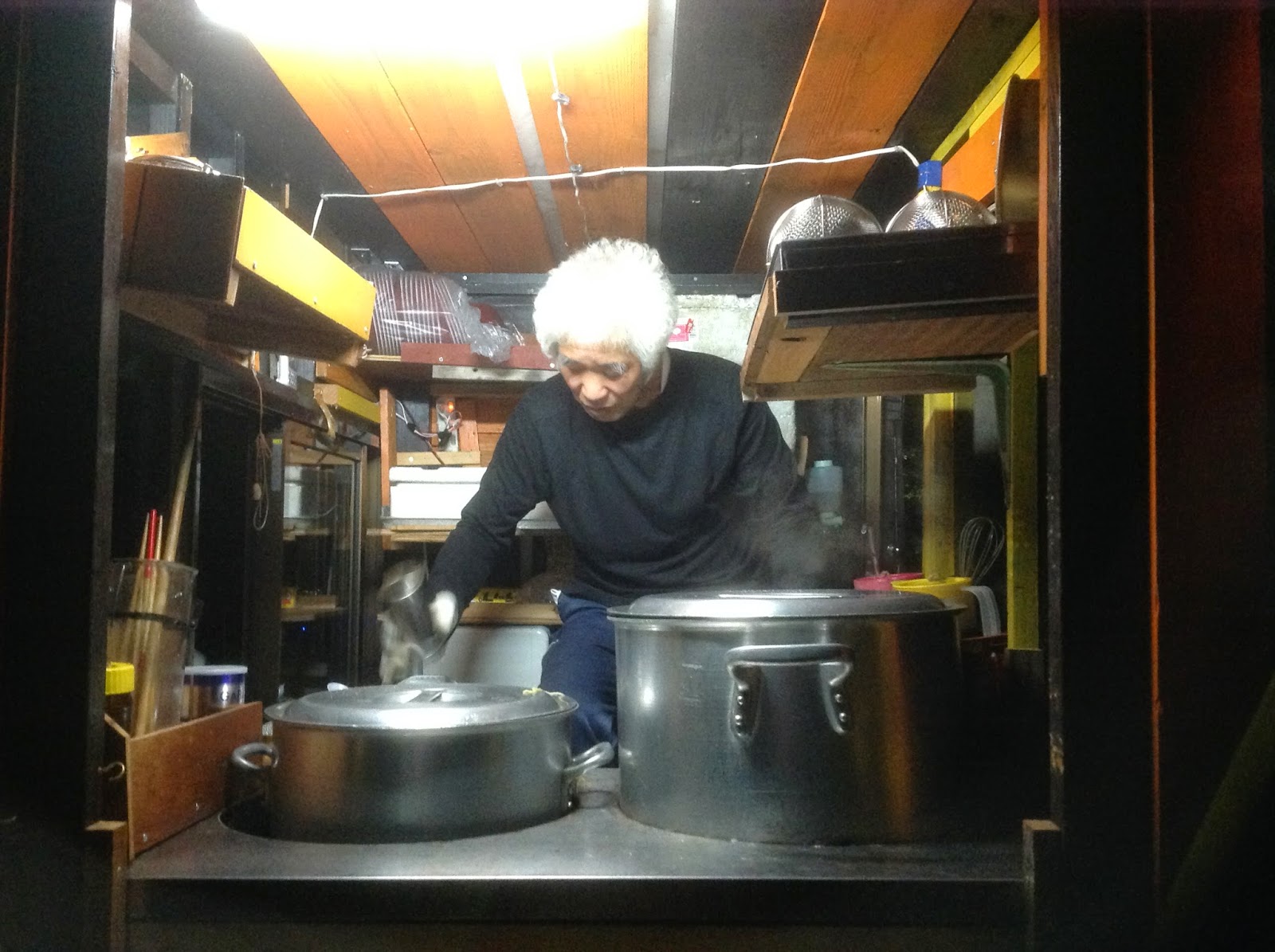
 And most gloriously of all - the surrounding Akita citizens have compensated for the lack of sustenance availability with the introduction of the Ramen truck. Insert first photo here please. Yes, the Ramen truck. This is not a drill.


 This lovely older Japanese couple sells a marvelously delicious soy sauce based ramen complete with pork, bamboo, scallions, etc, for 650 yen. Less if you bring your own bowl. The ramen truck arriving in Akita affects students like a piece of discarded food dropped in an ant hill. As word spreads throughout campus, more and more people rush to the back, consistently unoccupied road that connects Akita to the surrounding community. Even after just a few visits, I as a newcomer can easily tell by the way people move when the Ramen truck has arrived. 

The most common places to eat are outside the bar (weather permitting – I hear we’re up for some serious snow in winter), privately in rooms, and in Komachi lounge. Technically speaking, you can eat at the Ramen truck, but as the owners are Japanese, I would feel too intimidated to engage in conversation with them for as long as it takes me to eat their delicious food.


The Ramen itself is cooked to order. Noodles are rolled ahead of time, and dunked in some kind of water or broth to cook. Although commercial Ramen shops often offer a variety of options (esp salt, soy sauce, and miso) most smaller shops and the truck develop one recipe, and only serve that. At this particular truck, they make a soy sauce Ramen. I highly recommend it. Although other people will say to go to the more famous Ramen place in town, I think that our little truck is worth the trek to AIU!

Tuesday, September 2, 2014

As I Set Out on This Journey (Paula/ポーラ)

"As I set out on this journey" seems like an ill-fitting phrase as I write on an airplane to Hong Kong.  During the entirety of my time over the summer and at home before the trip, I approached my exchange experience with a feeling of dread; dread I feel burning in my stomach even now as I sit somewhere outside of the terminal at O'Hare Int'l. I look out my window at the yellow and grey of lines on pavement. The last time I was on an airplane was my sophomore year of high school on my first trip to Japan.  I remember the feeling of excitement of being in a new place and the misery of being in a culture devoid of touch. I imagine I will have a more manageable kind of wonder this time around. Maybe I will have none at all. I remember being culture sick during my three-week stay and imagine the ache of being separated from home, culture, and family for five months. I remember the ear popping, stomach dropping, bladder testing, hungry, tiring plane flight to and from Japan, and I understand why people are afraid of flying.

Hong Kong Airport; boarding for Narita

God bless the TSA. They make it just hard enough to get on a plane that the idea getting off; changing your mind at the last minute and running back to the people who love you causes cognitive dissonance strong enough to keep me in my seat. I watch the trailer for "Divergent" on a tiny television set that strains my farsighted eyes and make small talk with the woman sitting next to me. She is going to China for a year. She makes me seem like a pansy, and assures me that they will have Mexican food in Japan, it just won't be any good. As the plane readies itself to take off, the summer air warms my feet. I have never been afraid of flying; I'm not afraid to be alone; and I won't get through this -- I will love it. I settle back into my seat as we take off, and after 20 minutes of watching the blue line move like an elegant and expensive toy, crawl like a caterpillar, and finally disappear, I feel a little closer to the Dauntless.